Als bisher weitgehend unbekannter, jedoch
interessanter Lösungsansatz hinsichtlich einer besseren Fernsehnorm
erweist sich der auch praktisch vorgeführte Vorschlag des international tätigen
Unternehmens Philips in Holland:
1948 war deren Ansatz, das amerikanische 6 MHz
Kanalraster als Maß der Dinge zu nennen, was Angesichts der noch
bevorstehenden Frequenzknappheit in Europa auch einen sehr sinnvollen Lösungsweg
dargestellt hätte:
Die Rechnung lautet: Die rund 4,2 MHz mögliche
Videobandbreite der 525/60 Norm innerhalb des 6 MHz Kanalrasters sind auf
die 50 Halbbilder umzurechnen: 4,2 MHz
bei 30 Vollbildern ergeben ~280.000 Bildelemente/Pixel pro Vollbild.
Bei rund 485 aktiven Zeilen und einem 4:3
Bildseitenverhältnis des amerikanischen Systems ergibt die Umrechnung
eine vertikale brutto Zeilenzahl von 567 die sich aus der Einsparung der
Übermittlung von 5 Vollbildern pro Sekunde im europäischen 50 Hz System
ergibt.
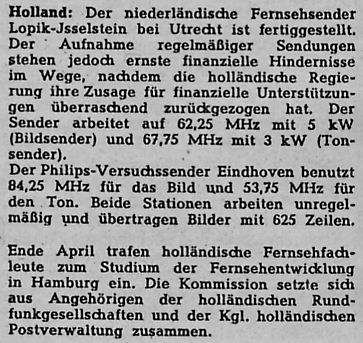
Dazu der Pressetext aus dem österreichischen Magazin
„Funktechnik“ Heft 2 1948:
Zwei Jahre später, im Sommer 1950 war auch dieses Thema
bereits Geschichte, wobei nachvollziehbare Begründungen für die
Ablehnung (bis jetzt) im verborgenen blieben.
Für die gerätetechnische Vereinfachung der Empfänger
wäre dieser Weg für Philips, einem weltweit agierenden Großkonzern
sicher entgegenkommend gewesen. (weltweit baugleiche Tuner u. ZF Kreise
etc.)
Wie es mit der Fernsehstandardnormierung weiterging
lesen sie in DIESEM Artikel
Auf mein ersuchen an Sammler und Fachkollegen erging
die Frage:
Dies sind hier deren interessante Antworten:
Ein Leser schrieb:
Hallo Herr Scheida,
Warum genau der Vorschlag von Philips keine Berücksichtigung bei der CCIR
gefunden hat kann man wohl vermuten, mir ist kein Dokument darüber
bekannt, außer, dass die CCIR im Sommer 1951, sich auf keine Empfehlung,
sondern nur - wohl auf Druck der Engländer - 4 Systeme
"registriert" hat.
Das waren:
1. 405 Zeilen (engl.)
2. 525 Zeilen (us)
3. 625 Zeilen (Genfer Norm - Dänemark, Deutschland, Holland, Italien,
Schweden und Schweiz)
4. 819 Zeilen (franz.)
Eine Empfehlung erging nicht zu einer Norm, (die damals erhoffte
"Weltnorm") sondern es wurden "nur" Empfehlungen zu
Kenngrößen gegeben:
Bildformat: 4:3
Zahl der Teilbilder: 2
Teilbildfrequenz: Unhabhängigkeit vom speisenden Netz (bis heute nicht
erreicht)
Modulation des Bildsenders: Amplitudenmodulation
Hochfrequenzübertragung: Restseitenbandverfahren (Empfänger mit
Nyquistflanke)
Begrenzung der Seitenbänder: Oberes oder unteres Seitenband (Träger
ungeschwächt)
Lage der Trägerfrequenzen Bildträger 1,25 MHz
innerhalb des Kanals: Tonträger 0,25 MHz
Dämpfung der Seitenbänder: mind. 20 dB
Danach war die "Genfer Norm" der Philips Version aus verschiedenen Gründen
überlegen.
Eine ausführliche Abhandlung zu diesem Thema findet sich in:
Buch: "Fernsehen"
Vorträge über neuere Probleme der Fernsehtechnik
herausgegeben von Dr.G Leithäuser und Dr.Ing. F Winkel
erschienen im Springer-Verlag 1953,
Seite 25 ff. "Der Stand der internationalen Normung der
Fernsehsendungen" Von Prof. Dr.Ing. F. Kirschstein
Warum die "Philips Norm" so einfach von der Bildfläche
verschwand, wird dort nicht explizit gesagt, aber durch die sehr ausführlichen
Gegenüberstellungen der
"4 registrierten Normen" kann man es nachvollziehen.
Bei Interesse bin ich gerne bereit Ihnen den Vortrag zu kopieren (scannen).
Gruß aus Kassel
Arno B.
Jan J. hat mir geschrieben: (Original Text siehe rechts in Englisch)
Vielen Dank dafür!
"Hallo Wolfgang,
offizielle zuverlässige Informationen über den 567 Zeilen Standard sind
etwas begrenzt.
Tatsache ist, dass Philips diesen Standard ernsthaft in Europa
vorschlagen wollte. Aus theoretischer (und auch praktischer) Sicht schien
er damals der ideale Standard zu sein. Er bot einen guten Kompromiss
zwischen Bildqualität und Kosten. Er enthielt bereits FM-Ton, negative
Bildmodulation, gute Synchronisationsimpulse, ein Seitenverhältnis von 4
zu 3 usw.
Und vor allem sah es so aus, als wäre es sofort technisch machbar, ohne
übermäßige Produktkosten. Aber anfangs unternahm Philips nur sehr wenig,
um ihn außerhalb der Niederlande umfassend zu bewerben (wir sprechen von
1947 und Anfang 1948).
In der Zwischenzeit schlugen die meisten europäischen Länder mehr oder
weniger einen 625 Zeilen Standard vor.
Das Vereinigte Königreich hatte kaum eine andere Wahl, als den
405-Linien-Standard für einige Zeit beizubehalten, weshalb es sich nicht
wirklich aktiv an den Diskussionen beteiligte. (Frankreich hat aus eigenen
Gründen immer eine eindeutige Wahl bevorzugt.)
Als Philips sich schließlich mehr bemühte, für den 567 Zeilen Standard
zu werben und ihn zu fördern, hatten sich die anderen Länder inoffiziell
auf 625 Zeilen geeinigt. Für den CCIR-Ausschuss versuchte Philips also,
den 567er-Standard zu verwenden, musste aber sehr bald feststellen, dass
andere Länder den 625er-Standard übernehmen würden.
Dies würde einen sehr begrenzten Absatzmarkt für Philips bedeuten (NL
und möglicherweise den niederländischsprachigen Teil von Belgien).
Philips erkannte die Folgen der isolierten Verwendung von 567 Zeilen
und der damit verbundenen Unmöglichkeit, Fernsehgeräte und -teile zu
exportieren (wer kauft schon von einem Bäcker, der sein eigenes
(625-Zeilen-)Brot nicht isst?) und stellte rasch auf 625 Zeilen um (1950).
Und das war das vorzeitige Ende der 567 Zeilen. In den Niederlanden gab
es noch keine Massenproduktion oder regelmäßige Fernsehübertragungen
(abgesehen von den Eindhovener Versuchsübertragungen mit 567 Zeilen), so
dass es kein Kompatibilitätsproblem gab. In der Zwischenzeit arbeitete
Philips hart an der Entwicklung seiner ersten Seriengeräte (625 Zeilen):
dem TX400U (22 cm Bildröhre) und dem TX500U (identisches Gehäuse, aber 31
cm Bildröhre).
Zum Start des "offiziellen" Fernsehdienstes, der mit Philips-Geräten
und Philips-Personal aus dem Zentrum der Niederlande ausgestrahlt wurde,
waren nur einige Hundert TX400U verfügbar.
Der Tag der Eröffnung war der 2. Oktober 1951.
Die TX400/500-Geräte
unterschieden sich völlig von den Versuchsgeräten mit 567 Zeilen.
Spezielle Fernsehröhren waren in der Zwischenzeit entwickelt worden und
alle Transformatoren (einschließlich der
Hochspannungserzeugung-/Horizontalausgangs) waren ebenfalls anders. Von
den 567-Zeilen-Geräten (die schon von sich aus in der Stückzahl begrenzt
waren) wurden wahrscheinlich nur wenige an den "neuen" Standard angepasst.
Der komplette VHF-Teil dürfte etwas anders sein (größere Bandbreite),
ebenso wie die Zeilenendstufe. Diese 567 Zeilen Geräte wurden
ausschließlich von Philips und Philips-Ingenieuren für alle möglichen
Tests verwendet.
Einige von ihnen wurden mit nach Hause genommen und nach der
Erstellung von Empfangsberichten für weitere Tests und Modifikationen
wieder in die Labors zurückgebracht. Auf 567 Zeilen wurden nur
experimentelle Sendungen ausgestrahlt. Die Zahl der verschiedenen
Fernsehgeräte für diesen Standard ist folglich auch begrenzt.
Philips selbst hat zwei verschiedene Geräte hergestellt:
* Projektionsfernseher (6 cm Projektionsröhre) mit Radio. Dieses Gerät
wurde sowohl für Tests als auch für Werbezwecke verwendet. Man sieht
überall das gleiche Bild (405-Zeilen-Version).
Es soll sowohl eine 567- als auch eine 405- und eine
441/445-Zeilen-Version gegeben haben. Das Seitenverhältnis der 405er
Version wäre natürlich ein anderes (damals noch 4 zu 5), aber ansonsten war
das äußere Erscheinungsbild aller Versionen identisch.
Der 405-Zeilen-Empfänger hatte ein völlig anderes Sichtgehäuse als die
567-Zeilen-Version.
* 22 cm Direktsicht, Einkanal (keine Abstimmung), Tischmodell Um das
Fernsehen populär zu machen und der (technischen) Öffentlichkeit die
Möglichkeit zu geben, sich mit dem Fernsehen vertraut zu machen, wurde
1949 eine Broschüre von J. Jager (Philips) herausgegeben ("Een
experimentele televisieontvanger").
In dieser Broschüre wurde ein Fernsehgerät beschrieben, das aus
einfachen Teilen gebaut werden konnte. Fast alle Teile konnten bei
Philips-Händlern gekauft werden, und der Entwurf verwendete fertige
Transformatoren von Philips. Die Broschüre enthielt einen Vorschlag für
das Chassis und den Bau des Fernsehers. Es sind nicht viele gebaut worden,
aber es ist eine interessante Lektüre.
Die meisten Amateure, die tatsächlich einen funktionierenden Fernseher
bauten, verwendeten Oszilloskop-Röhren und machten ihre eigenen Entwürfe.
Sie ließen sich dabei von Veröffentlichungen in verschiedenen
Zeitschriften leiten.
Ich bin mir sicher, dass ich irgendwo einen Artikel (in einer
Zeitschrift?) habe, in dem die Situation im Zusammenhang mit der schnellen
Umstellung von der 567- auf die 625-Zeilen-Norm (auf Druck anderer Länder)
kurz erläutert wird. Ich werde sehen, ob ich ihn finden kann und dann
einen Scan für Sie anfertigen. Ich hoffe, dass das oben Gesagte ein wenig
hilft und etwas Licht in die obskuren 567 Zeilen Periode bringt."
Viele Grüße aus Eindhoven, Jac J.